Cost Comparison: Surplus Stores vs. Traditional Retail
Ever wonder why two nearly identical tools can cost $80 at a hardware chain and $22 at a surplus store down the street? It is not a mistake, and it is not a trick. The answer lies in how surplus stores actually work, and once you understand it, you will probably rethink where you shop for a whole range of everyday things.

Surplus stores operate on a fundamentally different supply chain than your typical big-box retailer. They buy goods that fell out of the normal distribution cycle, things like overstock, customer returns, closeout lots, liquidated inventory from bankrupt companies, and even government auction merchandise. Because they paid a fraction of original wholesale cost to acquire that inventory, they can pass real savings on to shoppers. This is not charity. It is just math. And for cost-conscious consumers who are tired of paying full price for products that end up being perfectly fine, surplus shopping has quietly become a very smart habit.
This article walks through exactly how the pricing difference works, breaks it down category by category, talks honestly about quality concerns, and uses real directory data to show just how active and accessible this market really is. By the end, you will have a clear picture of where surplus stores genuinely beat traditional retail and where they don't.
How Surplus Stores Source Their Inventory (And Why That Changes Everything)
Most people have a vague sense that surplus stores sell "cheap stuff," but that framing misses what is actually going on behind the scenes. Surplus retailers are buying inventory through channels that traditional stores never touch. When a major retailer over-orders a seasonal product and cannot sell through it by a certain date, that excess stock gets bundled and sold off, often at 10 to 30 cents on the dollar, to liquidators or directly to surplus buyers. The same thing happens with customer returns, even when items come back in perfectly working condition. Big retailers often can't cost-effectively repackage and restock returned goods, so they move them out in bulk.
Government auctions are another big source. Federal agencies, military branches, and municipalities regularly sell off equipment, vehicles, clothing, and supplies that are no longer needed. Some of this stuff is well-used, sure, but a lot of it is in excellent shape and priced absurdly low because the government's goal is disposal, not profit. Surplus stores that specialize in military gear, in particular, tend to source heavily from these channels.
Now contrast that with how a traditional retailer prices its shelves. A product moves from manufacturer to distributor to regional warehouse to store floor, and each link in that chain adds its own margin. By the time something is priced on a shelf at Target or Home Depot, it reflects the manufacturer's production cost, their markup, the distributor's cut, shipping and warehousing fees, and the retailer's own margin requirement. Then add in what they spend on advertising, store design, and loyalty programs. You're not just paying for the product. You are paying for the entire infrastructure that got it to you.
Surplus stores skip most of that. They pay low acquisition prices, operate leaner (and yes, sometimes slightly messier) store environments, and don't spend millions on national ad campaigns. That is how a $90 pair of work boots ends up on a surplus shelf for $35.
Surplus retailers typically acquire inventory at 10–30% of original wholesale cost. Even after their own markup, they can still price products at 30–70% below standard retail. In practice, the savings are real because the acquisition cost is genuinely lower, not because corners were cut on the product itself.
Category-by-Category: Where the Savings Are Actually Biggest
Not every category offers the same discount at a surplus store. Some product types show up in surplus channels constantly and at massive markdowns. Others show up rarely or with only modest savings. Knowing the difference before you walk in saves time and helps set realistic expectations.
Tools and hardware are one of the best categories for surplus shopping. Overstock from home improvement retailers and liquidated contractor supply lots flow into surplus stores regularly. Savings of 40 to 60 percent off standard retail are common. You might find a brand-name cordless drill for $45 that sells for $110 at Lowe's, or a set of socket wrenches for $18 instead of $55. These items are often shelf-pulls, meaning they were on a store shelf but never sold, so the only thing "wrong" with them is that they didn't move fast enough for the original retailer.
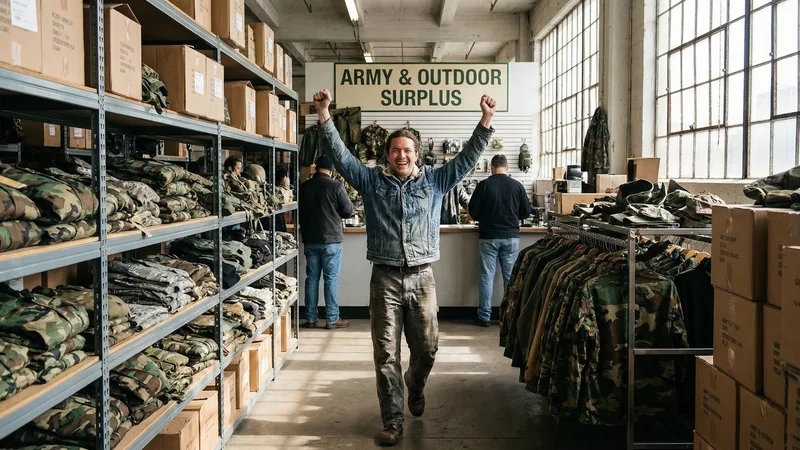
Clothing and footwear can also yield big savings, especially in military surplus stores where government-issue gear, tactical clothing, and work boots come through in large quantities. Savings here range from 30 to 70 percent depending on the item. One weird thing I noticed at a surplus store recently: the price stickers are sometimes handwritten in marker on masking tape, which looks informal but honestly just means they priced it fast, not that the item is low quality.
Outdoor and camping gear is a strong category too. Tents, sleeping bags, backpacks, and camp cookware show up frequently, often sourced from outdoor retailer closeouts or military lots. A sleeping bag rated to 20 degrees that costs $180 at REI might be $60 at a well-stocked surplus store.
Electronics are trickier. You can find real bargains on things like cables, batteries, basic accessories, and older-model electronics, but this is a category where condition matters a lot and where "as-is" sales can sting you if you are not careful. Savings exist, but you need to inspect carefully.
Household goods like cleaning supplies, storage containers, and basic kitchen items often appear in surplus stores at 20 to 40 percent below retail. Not always the most exciting buys, but if you are stocking up on practical supplies, the savings add up quickly.
Traditional retailers use consistent, brand-reinforced pricing across all these categories. A Stanley tool or a Columbia jacket costs roughly the same whether you are in Chicago or Phoenix because those brands control their pricing structure tightly. Surplus stores, by contrast, price based on what they paid for a specific lot, which means prices vary a lot from store to store and week to week. That inconsistency is actually the point. If you shop these places regularly, you start to learn when to grab something and when to wait.
Quality and Value: The Honest Conversation
Let's not pretend every surplus item is a hidden gem. Some of it is perfectly fine. Some of it has issues. And a small percentage of it is genuinely not worth buying at any price.
Understanding the difference between product conditions is important before spending anything. "Shelf-pull" means it sat on a retail shelf and never sold. These items are almost always in great condition. "Open-box" means someone bought it, opened the packaging, and returned it. Often nothing is wrong, but you should check that all parts are included. "Slightly damaged" could mean a dented box, a scuff on an outer surface, or something functionally fine with cosmetic wear. "As-is" or "sold as found" is where you need to be careful, because that usually means no testing has been done and no returns are accepted.
Warranty coverage is a real consideration. Most surplus items come without manufacturer warranty because they were sold outside official retail channels. For a $20 item, that's probably fine. For a $200 piece of electronics, it matters more. Return policies at surplus stores also vary widely, and many have strict no-return policies on certain categories. Know that before you buy.
That said, for durable goods like hand tools, work clothing, outdoor gear, and basic hardware, the lack of a warranty is rarely a dealbreaker. These items either work or they don't, and you can usually tell by examining them in the store. Informed shopping here means spending two minutes inspecting an item before putting it in your cart rather than assuming it's fine because the price is good.
High-value finds at surplus stores are absolutely real. But so is the "this seemed like a deal" regret purchase. Take a beat before buying something just because it's cheap.
Shelf-pull: Usually excellent, never used. Open-box: Check for completeness. Slightly damaged: Inspect the actual function, not just cosmetics. As-is: Buyer beware, no returns expected. When in doubt, ask the staff what they know about the lot it came from.
What the Directory Data Actually Tells Us
Some people still think of surplus stores as obscure, regional oddities tucked in strip malls outside of town. That picture is outdated. Surplus Store Finder currently lists 223 businesses across multiple cities, with an average customer rating of 4.5 stars. That rating, averaged across hundreds of individual reviews, tells you something real: shoppers who go to these places are largely satisfied with the experience.
Fayetteville, NC leads all cities with 6 listings, which makes sense given its proximity to Fort Bragg and the large military community there. Columbus, GA has 4 listings, also driven in part by Fort Benning. Houston, Las Vegas, and Jacksonville each have 3 listings, showing that surplus retail is active in major metro markets well beyond military towns. This is not a niche corner of retail anymore. It is a live, accessible market in cities where millions of people shop every day.
And the top-rated stores in the directory are genuinely impressive. Drop Zone Military Surplus in Fayetteville, NC holds a perfect 5.0 stars across 1,068 reviews. That is not a small sample. Silverback Military Surplus, also in Fayetteville, sits at 5.0 stars with 353 reviews. ARK Tactical Inc in Richmond, KY has 218 reviews at 5.0 stars. Gibsons Tactical Tavern in Columbus, GA and HUSKY TACTICAL in Lakewood, WA round out the top tier, both at 5.0 stars. Across very different cities and store types, these ratings cluster at the top, which suggests that the surplus shopping experience, done right, genuinely delivers for customers.
| Business Name | Location | Rating | Reviews |
|---|---|---|---|
| Drop Zone Military Surplus | Fayetteville, NC | ⭐ 5.0 | 1,068 |
| Silverback Military Surplus | Fayetteville, NC | ⭐ 5.0 | 353 |
| ARK Tactical Inc | Richmond, KY | ⭐ 5.0 | 218 |
| Gibsons Tactical Tavern | Columbus, GA | ⭐ 5.0 | 123 |
| HUSKY TACTICAL | Lakewood, WA | ⭐ 5.0 | 113 |
If you are also trying to cut grocery costs on top of general household spending, it is worth knowing that a similar surplus model exists in the food world. Salvage grocery options in your area operate on a comparable principle, moving overstock and near-date food products at steep discounts. Typically, the same logic that makes surplus tools a smart buy applies to surplus groceries too.
Practical Tips for Getting the Most Out of Surplus Shopping
Okay, so you're convinced it's worth trying. Here is how to actually do it well.
Visit often. Surplus stores do not restock like traditional retailers do, where you can count on a product being there next week. Inventory turns over constantly based on what lots come in. A store that had nothing interesting last Tuesday might have a pallet of name-brand work gear this Saturday. Regulars at these stores know this and treat it almost like a hobby, stopping in once or twice a week just to see what's new.
Get there early when shipments arrive. Most surplus stores have regular days when new inventory hits the floor, and the best stuff goes fast. Talk to staff. Ask when new lots typically come in. Build a little rapport. Staff at good surplus stores are often genuinely knowledgeable about their inventory and will tell you things that aren't posted anywhere, like "we just got a big lot of Carhartt jackets in the back that hasn't been sorted yet."
Set a budget before you walk in. This sounds obvious but it is surprisingly easy to ignore. Surplus stores are set up in a way that rewards impulse buying, because everything looks like a deal. And some of it is. But buying six things you sort of want because they're each only $8 is still spending $48 on stuff you didn't need. Go in with a category in mind and a number in your head.
Use an online directory before you make the trip. Surplus stores vary enormously in what they specialize in. Some focus almost entirely on military surplus. Others carry mostly household goods or tools. Some do a mix. Reading reviews and checking store descriptions on Surplus Store Finder before driving across town saves you from showing up at a military gear shop when you needed camping equipment. Check ratings, read what reviewers mention finding, and look at how long the store has been listed.
Check the store's reviews for mentions of specific product categories. A store with dozens of reviews mentioning "tools" or "outdoor gear" is telling you what they actually carry. Don't rely on the store name alone. "General surplus" can mean almost anything.
When Traditional Retail Is Still the Right Call
Surplus stores are not the right answer for everything. This is worth saying plainly because the enthusiasm for a good deal can sometimes cloud judgment about when it doesn't apply.
If you need something specific and you need it today, traditional retail wins. Surplus stores cannot guarantee availability of any particular item. You cannot call ahead and ask if they have a specific size in a specific product. If you're buying a gift with a deadline, or replacing something that broke and you need it working by Thursday, the predictability of a traditional retailer is worth paying for.
Specialty items with precise specifications are also better bought through official channels. Medical equipment, safety gear that has to meet specific certifications, or electronics that need to be compatible with existing systems, these are not places to gamble on an as-is surplus find. As a rule, the cost savings on the front end can be wiped out very quickly by a safety failure or an incompatibility problem.
High-stakes purchases also deserve full manufacturer support. A new furnace, a major appliance, a vehicle, anything where you will need warranty service, manufacturer support, or an official service network should go through traditional retail or authorized dealers. For most shoppers, the upfront savings at a surplus store won't offset one service call that can't happen because there's no warranty attached.
And honestly, for clothing where sizing consistency matters, traditional retail is just easier. Surplus clothing lots are often mixed sizes and conditions, and unless you're trying things on in-store, the odds of getting exactly what you need are lower than at a regular store with consistent inventory.
A balanced approach works best. Surplus stores for tools, gear, work clothing, outdoor supplies, and household basics. Traditional retail for time-sensitive, spec-critical, or warranty-dependent purchases. Knowing which bucket a purchase falls into before you start shopping saves money and frustration.
Worth noting: the same kind of smart sourcing logic that makes surplus stores valuable for general goods extends to food shopping. Discount salvage grocery stores apply the same overstock and closeout model to everyday food items, and for budget-focused households, combining both types of shopping can make a real dent in monthly spending.
Frequently Asked Questions
Are surplus store items actually new?
Many are, yes. Shelf-pulls and overstock items have never been used. Open-box returns are often in fully working condition. But not everything is new, and condition varies. Always inspect items before buying and ask staff about the source of a lot if