Seasonal Surplus Store Finds: Best Deals for Each Holiday
Why Surplus Stores Are the Smart Shopper's Secret Weapon
223 surplus stores across five major American cities, averaging 4.5 stars from real customers. That number stopped me cold when I first looked at the directory data, because it tells you something important: this is not some niche, dusty-corner shopping habit. This is a mainstream retail strategy that hundreds of thousands of people are already doing, and doing well.
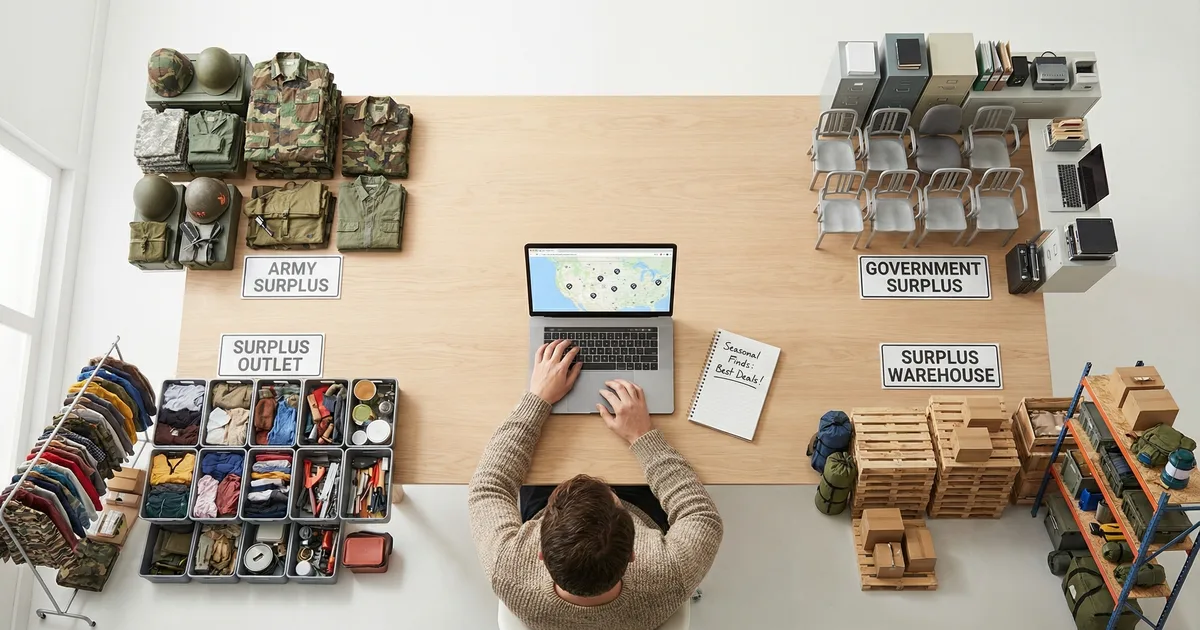
Here's what most people don't know about the holiday retail cycle. Every year, American retailers over-order seasonal merchandise by enormous margins, because running out of stock costs them more than sitting on excess. After each major holiday, that unsold inventory has to go somewhere. It gets offloaded in bulk to surplus stores, liquidation companies, and discount retailers who can move it fast and cheap. We're talking about artificial Christmas trees still in their boxes, unopened Valentine's candy assortments, Easter decorations in original packaging, full-size Halloween costumes with tags on. Not damaged goods. Not rejects. Just stuff that didn't sell at full retail price and now needs a new home.
This guide is built for people who want to shop these stores with a plan. Not wander in hoping for luck, but actually show up at the right time, knowing what to look for, armed with a list and a budget. Each major holiday season creates its own wave of surplus, and if you learn to ride those waves, you can cut your holiday spending by 40 to 70 percent without any sacrifice in quality. That's not an exaggeration. It's just math.
What the Directory Data Actually Tells Us About Surplus Shopping
So let's talk about the numbers for a moment, because they paint a more interesting picture than you might expect. Across the Surplus Store Finder directory, 223 businesses are listed spanning five major cities: Fayetteville leads the pack with 6 listings, Columbus sits at 4, and Houston, Las Vegas, and Jacksonville each come in at 3. That clustering matters. Surplus stores don't pop up randomly. They tend to settle near large distribution hubs and high-density retail corridors, because that's where the overstock flows from.
Fayetteville's dominance in the directory is interesting when you consider the city's size relative to a place like Houston. Fayetteville has a strong military retail culture, and military surplus has long overlapped with general liquidation merchandise. Two of the top-rated stores in the entire directory are there: Drop Zone Military Surplus sitting at a perfect 5.0 stars across 1,068 reviews, and Silverback Military Surplus also at 5.0 stars with 353 reviews. Those review counts are not flukes. A thousand reviews at five stars means something.
Outside North Carolina, ARK Tactical Inc in Richmond, Kentucky has earned 5.0 stars from 218 customers. Gibsons Tactical Tavern in Columbus, Georgia pulls 5.0 stars from 123 reviews. HUSKY TACTICAL in Lakewood, Washington rounds out the top five with 5.0 stars from 113 reviews. Notice something? Several of the highest-rated surplus operations in the country lean military or tactical. That's partly a review bias thing (military shoppers tend to leave detailed, loyal reviews) but it also reflects genuine quality control. These stores move a lot of merchandise and they've built real reputations.
A 4.5-star average across 223 businesses is genuinely impressive for any retail category. For context, most grocery store chains average somewhere around 3.8 to 4.1 stars. The surplus store category punching above its weight in customer satisfaction suggests that shoppers who find these places come back, and they tell people about it.
Filter by your city first, then sort by rating. During the two weeks after any major holiday, prioritize stores with the highest review counts, not just the highest stars, because review volume tells you how active and well-stocked a location typically is. Stores in top-listed cities like Fayetteville and Columbus have the most competitive local surplus markets, which usually means better prices and faster inventory turnover.
If you're in Houston or Las Vegas, both cities with 3 listings each, it's worth noting that proximity to major distribution centers in those metros means inventory often restocks faster than in smaller markets. Las Vegas in particular is surrounded by large-scale logistics operations that feed the casino and hotel industry, and seasonal overstock from those sectors occasionally flows into local surplus stores. You won't find that mentioned in most shopping guides.
Winter Holiday Season: Thanksgiving Through New Year's (October, January)
January is the golden month for surplus shopping. Full stop.
Every year, in the first two weeks of January, retailers finish offloading their unsold Christmas merchandise in bulk. Surplus stores receive enormous shipments during this window: artificial Christmas trees still boxed, strings of lights, ornament sets, gift wrap in huge rolls, holiday kitchen items (all those themed mugs and serving platters that people buy as gifts and nobody uses), and winter apparel that didn't move fast enough. Prices during this period can be 60 to 80 percent below what you'd pay at a chain retailer in November.
Electronics and toys deserve special attention in January. These are the most commonly returned post-Christmas gift categories, and a lot of that returned merchandise flows through liquidation channels into surplus stores. An opened-box tablet or gaming accessory that retails for $120 might show up at a surplus store for $35 to $50. Not always, but often enough that it's worth checking.
There's also a less talked-about early window: late October and early November. Some surplus stores receive pre-season overstock from retailers who are clearing warehouse space to make room for incoming holiday stock. You can sometimes find Christmas merchandise in early November at surplus stores before it ever hits regular retail shelves, at already-discounted prices. Counterintuitive, but real.
Before your January surplus run:
- Write down what decorations you want to replace or add for next year's holiday season while your memory is fresh
- Measure your storage space for items like artificial trees (ceiling height in your display area, not just the box dimensions)
- Set a separate "next Christmas" budget category so you don't blow your January grocery money on ornaments you don't need until December
- Check the Surplus Store Finder for your city and identify two or three stores to visit across the first two weeks of January, inventory varies wildly between locations
- Bring a phone charger or portable battery if you plan to price-compare. You'll be googling retail prices in the aisle more than you expect
One practical tip that most guides skip: bring measurements. I cannot count the number of times people buy a surplus Christmas tree and get home to find it's two feet taller than their ceiling allows. Surplus stores usually don't accept returns, and the box dimensions don't always match the assembled height listed on the label. Measure your space before you go, write it on your phone's notes app, and check it in the aisle before you buy.
Gift wrap and packaging supplies are criminally underrated surplus buys. A retail store might sell a 30-foot roll of wrapping paper for $6. A surplus store in early January will often have multi-roll packs for the same price. Buy more than you think you need. It keeps fine in a closet and you'll use it next year.
Spring Holiday Season: Valentine's Day, Easter, and Mother's Day (January, May)
Spring is where surplus shopping gets interesting in a different way, because you're dealing with three distinct holidays in a compressed window, each with its own merchandise wave.
Valentine's Day surplus hits stores in mid-to-late February. Chocolate assortments (often still well within their best-by dates), candle sets, small gift items, red and pink decorative pieces, and greeting cards all show up in volume. The candy is the best deal here, genuinely. Chocolate doesn't spoil quickly, and a box of chocolates at 70 percent off is a box of chocolates. Buying Valentine's candy in late February for gifts throughout the year sounds weird until you do it once and realize it's just... smart.
Easter surplus lands in April and early May, right after the holiday. This is one of the best seasonal windows for home décor shoppers because Easter merchandise tends to be neutral enough to use year-round: pastel-colored baskets, spring-themed table runners, ceramic pieces that read as "spring" rather than strictly "Easter." Surplus stores fill up with this stuff quickly after the holiday. Plastic Easter eggs in bulk, stuffed animals, candy (again, worth buying), and spring gardening accessories that retailers bundle with Easter merchandise.
And while we're talking about stocking up on food-adjacent items at discount prices, it's worth knowing that salvage grocery options in your area follow a similar logic, seasonal and overstock food items at deep discounts, often from the same retail supply chain that feeds surplus stores. Worth bookmarking if you're serious about this kind of shopping.
Mother's Day is trickier. Surplus from Mother's Day tends to be less predictable in category because it's a more gift-diverse holiday. But candles, bath sets, kitchenware, and garden items all show up reliably in surplus stores in mid-to-late May. If your mother likes a particular type of item, it's worth checking surplus stores about a week after Mother's Day. You won't always find something, but when you do, the discounts are steep.
Mark these windows in your calendar:
- February 15–28: Valentine's Day surplus peaks. Best for candy, candles, and small gift items
- April 10–25: Pre-Easter overstock sometimes appears; post-Easter surplus hits fast
- May 12–20: Mother's Day surplus arrives. Hit stores within a week of the holiday for best selection
- Call ahead to your local surplus stores if possible. Ask if they've received any holiday overstock recently. Some will tell you straight up what just came in
Summer and Fall: Fourth of July, Back-to-School, and Halloween (June, October)
Summer surplus is a different animal. Fourth of July merchandise has a short surplus window because patriotic décor sells across a longer season, from Memorial Day through Labor Day, so retailers don't offload it as aggressively. But the week after July 4th, surplus stores do receive some influx of party supplies, outdoor entertaining items, and decorative flags. It's not the biggest surplus window of the year, but if you're planning a summer party in the following year, it's worth a quick stop.
Back-to-school is more about general merchandise surplus than holiday-specific items. Retailers over-order school supplies every August, and what doesn't sell gets liquidated fast because shelf space is immediately needed for Halloween. Surplus stores in late August and early September often have notebooks, pens, backpacks, lunch containers, and organizational supplies at 50 to 70 percent below regular retail. If you have kids, or if you work in an office, this window is worth paying attention to.
Halloween is where things get really good. And I mean really good.
Post-Halloween surplus, hitting stores in the first week of November, is one of the most consistently rewarding surplus shopping windows of the year. Full costumes in original packaging (people buy backup costumes they don't end up using), bags of individually wrapped candy in huge quantities, decorations, fog machines, lighting effects, plastic skeletons, animatronic pieces. In practice, the animatronic Halloween decorations especially tend to be expensive at retail ($40 to $150 for the good ones) and they show up in surplus stores in November for $10 to $30. These items come back into use every year and they last.
For your Halloween surplus run in early November:
- Target animatronic and electronic decorations first, they sell out of surplus stores faster than basic plastic décor
- Check costume sizing carefully. Many surplus costumes are returns and the size labeling can be inconsistent between brands
- Candy bought in early November stores fine through the following Halloween if kept cool and dry
- Foam and latex decorations can degrade in extreme heat or cold storage, so factor in your storage conditions before buying in bulk
One thing I noticed browsing through some of the top-rated stores in the directory: the best surplus stores tend to organize their seasonal merchandise by category rather than by holiday, which means a foam tombstone might be filed under "outdoor décor" rather than "Halloween." Worth doing a full walk-through rather than heading straight to an obvious holiday section. You find things that way. Strange things, sometimes. Good things.
Year-Round Surplus Shopping: Tips That Apply in Any Season
There are some habits that pay off regardless of which holiday window you're shopping in.
Go early in the week. Surplus stores restock over the weekend when they receive shipments, and Tuesday and Wednesday tend to offer the freshest selection before the weekend shoppers pick through everything. This is especially true in the days immediately after a holiday.
Know your prices before you walk in. Surplus stores price merchandise based on what they paid for it, not always based on retail value, which means you'll occasionally find something priced higher than a clearance sale at a regular retailer. Pull up Amazon or a big-box retailer's app on your phone and check before you commit. It takes ten seconds and saves real money.
Build a relationship with the staff if you shop a store regularly. Typically, the higher-rated stores in the Surplus Store Finder directory, places like Drop Zone Military Surplus with over a thousand five-star reviews, didn't build that reputation through random luck. They built it through staff who actually know their inventory and will tell regular customers when good merchandise is coming in. A quick conversation at the register can get you on an informal "heads up" list.
Storage is your competitive advantage. People who have dedicated storage space for surplus merchandise shop better than people who don't, because they can buy next year's holiday supplies without needing to use them immediately. A cheap set of plastic storage bins in a garage or basement can translate into hundreds of dollars saved annually just by enabling you to buy Christmas decorations in January and Easter baskets in April.
And honestly? Walk the whole store every time, even if you came in for one specific thing. Surplus inventory is unpredictable by nature. As a rule, the best finds are usually the ones you weren't looking for.
Frequently Asked Questions
When is the absolute best time to visit a surplus store for holiday deals?
Early January is the single best window of the year for sheer volume and discount depth. Retailers have just finished offloading unsold Christmas inventory, and surplus stores receive more holiday merchandise in those two weeks than at almost any other point in the year. Post-Halloween in early November is a close second, especially for decorations and costumes.
Are surplus store holiday items usually in good condition?
Most post-holiday surplus is unsold new merchandise, not returns. You'll find items in original packaging that simply didn't sell at full retail price. Some returned merchandise does show up, and it's usually marked as such or priced noticeably lower. Check packaging carefully for damage before buying, and understand that most surplus stores do not accept returns, so inspect before you buy.
How do I find a good surplus store in my city?
Filter by city in the Surplus Store Finder directory and sort by rating and review count. Stores with both high ratings and high review volumes (like Drop Zone Military Surplus in Fayetteville with 1,068 reviews at 5.0 stars) tend to be the most reliable for consistent inventory and customer service. In cities with multiple listings like Fayetteville or Columbus, visit more than one location because inventory varies significantly between stores.
Can I find food items at surplus stores?
Some surplus stores carry non-perishable food items, especially seasonal candy and packaged goods that are near but not past their best-by dates. For a broader selection of discounted food and grocery items, salvage grocery stores specialize in exactly that category and follow a similar overstock model.
Is it worth driving to a city with more surplus store listings?
For most people, no, not unless you're already going there for other reasons. But if you live near Fayetteville or Columbus and haven't explored their local surplus markets yet, those cities have enough competing stores to make a dedicated shopping day worthwhile. More competition between stores means better pricing and faster inventory turnover.
What should I never buy at a surplus store?
Be cautious with electronics that can't be tested in-store, car seats (safety standards are time-sensitive and hard to verify), and any item where you can't check the expiration date clearly. For everything else, the risk is generally low, especially at well-reviewed stores with established reputations.
More Ways to Save
Find Surplus Store Finder Near You
Browse our directory of 223+ businesses across the country, all with real customer ratings to help you find the best surplus store in your city before the next holiday window opens.
Search the Directory